
Disposable Formwork Systems

Disposable Formwork System
Disposable formwork increasingly meets the need of construction companies for environmentally friendly and cost-reducing solutions. In this context, permanent void formers offer a revolutionary alternative to traditional construction methods.
It provides flexibility to construction engineers and architects thanks to the necessary lightweight reinforced concrete elevated slabs. This innovative construction material provides solutions in construction fill areas and low slabs.
As the first and only in Turkey, GooPlast Disposable Formwork System is available in 125 mm or 200 mm pipe sizes. These pipe sizes are used for different load strengths and to create wide spans.
The Permanent Disposable Formwork System offers a lightweight construction fill solution instead of traditional fill materials such as sand, gravel, EPS and concrete. As it is a lightweight fill material, it provides cost and labor savings in construction projects.
Thanks to the flexible structure of the system and plastic void formers can be easily adapted to different ground levels. It allows projects to be realized more efficiently.
Apart from being a lightweight fill material, Disposable Formwork creates a hygienic void that eliminates moisture. When integrated with the ventilation system, the void structure made with disposable formwork effectively eliminates accumulated moisture and radon gas.

Disposable Formwork Usage Areas

Industrial Building

Pool Sides

Landscape Area

Parking Lot Elevation

Flood Water Protection Tank

Rainwater Collection
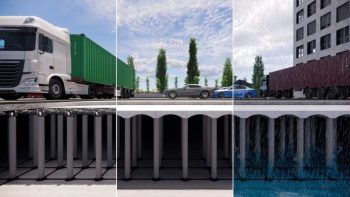
Parking Lot Drainage
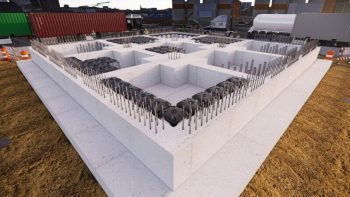
Construction Foundation
Disposable Formwork Advantages
Disposable formworks are single-use formworks used in reinforced concrete elevated slabs. Thanks to their lightweight and robust structures, they can be installed quickly and easily. Among the advantages of disposable formworks, the structure formed after concrete pouring carries high loads. Disposable formworks create reinforced concrete elevated slabs by forming hundreds of columns, arches and domes. This structure provides the reinforced concrete slab with high load-bearing capacity.
How to Apply Disposable Formwork?
Ground Preparation
As a first step, the ground where disposable formwork will be applied must be prepared properly. The ground should be compacted if necessary and a flat surface should be obtained. Laying geotextile felt on the ground is important to prevent moisture that may come from the ground.
Foot and Batten Assembly
The feet and battens that form the basis of the disposable formwork system are placed on the ground in a determined order. The feet form the support points on which the dome formworks will stand. The battens, on the other hand, provide connection between the feet and increase the strength of the system. At this stage, care should be taken to ensure that the system is level and even.
Dome Placement
After the foot and batten assembly is completed, the dome formworks are placed on the feet. The domes are easily assembled thanks to the interlocking system. Each dome forms a strong structure by connecting tightly with neighboring domes. This stage directly affects the load-bearing capacity of the system.
Reinforcement Placement
Reinforcement steel determined according to the project is placed on the dome formworks. The reinforcement provides the strength of the reinforced concrete slab. The diameter, spacing and placement of the reinforcement are determined according to static calculations. At this stage, it is critical that the reinforcement is placed correctly and in accordance with the project.
Concrete Pouring
In the final stage, concrete is poured over the reinforcement. The concrete creates a durable slab by covering the dome formworks. During concrete pouring, care should be taken to ensure that the concrete is distributed homogeneously and that the reinforcement is completely covered with concrete. After concrete curing is completed, the structure is ready for use. The disposable formwork system remains permanently under the concrete and provides continuous support to the structure.